Turn Your Selfie Into a 1990s VHS Home Video (Viral AI Trend)
A carousel from @chatgptricks turned 12 nostalgia prompts into a viral trend, and the VHS handycam variant stood out. Here is how it works, why ChatGPT Images 2.0 nails the analog texture, and the one-tap app we built around it.
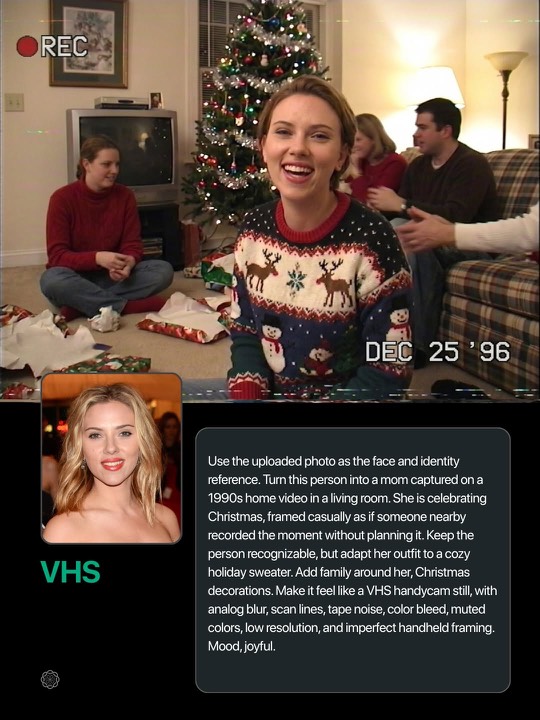
Turn Any Selfie Into a 1990s VHS Home Video Tape
Open Instagram this week and you'll see them everywhere — someone in a knit holiday sweater standing in front of a Christmas tree, framed a little off-center like the camera operator wasn't really looking, with a blinking "REC" indicator in the corner and a date stamp reading "DEC 25 '96" in the bottom right. It looks like something pulled off a dusty handycam tape your parents found in a shoebox. Except the person in the frame is your friend who posted it twenty minutes ago.
The trend, in one sentence
In late May 2026, a carousel from @chatgptricks racked up tens of thousands of saves by showing twelve nostalgia prompts that turn any portrait into a different analog era — VHS, Polaroid, PS1 graphics, MySpace, tabloid magazine, 1980s pixel art. The VHS prompt stood out early, partly because the texture is so distinct, partly because almost everyone has emotional weight tied to a 1990s home video they've actually seen.
The whole thing runs on ChatGPT Images 2.0, which OpenAI released earlier this year. Earlier image models could draw a face but struggled with overlay text like "REC" or "MAY 18 '96". GPT Image 2 reads those instructions and renders them cleanly. That's what separates "AI photo with VHS filter applied" from "looks like an actual frame from a tape."
Why it actually feels real
Two things are doing the work here.
First, the model itself. GPT Image 2 is unusually good at rendering imperfect surfaces — the kind of soft analog blur, scanline noise, and faded color bleed that the original 1990s handycams produced as a byproduct of cheap CCDs and tape storage. Earlier models would draw a clean photo and slap on an Instagram-tier grain overlay. GPT Image 2 bakes the imperfection into the render.
Second, the prompt structure. The viral template uses your uploaded photo as the identity reference and then rewrites everything around the face — outfit, scene, action, family, decorations, mood. That's different from "make this photo look retro." You're not filtering the original. You're staging an entirely new moment that happens to feature the same face. The output reads as a memory, not an edit.
Why this resonates
Real family videotape disappeared somewhere between 2005 and 2015, depending on when your parents stopped buying blank tapes. The format is genuinely gone. You can't shoot new 1996 footage anymore — even faking it convincingly required a working handycam, a fresh tape, and patience.
What's interesting is that the nostalgia isn't really for the era. It's for the texture. The proof that someone you loved was there with a camera, willing to record something mundane. A magic camcorder that captures any moment as if it had happened thirty years ago is honestly a pretty good consumer product, even if the moment itself never existed.
Make your own
We built VHS Home Video on AI Pass so you don't have to copy-paste the prompt from the IG carousel and tweak the variables by hand every time. Upload a portrait, pick a scene (Christmas living room, summer pool day, prom night, birthday, road trip, Halloween), pick who you are in the tape, optionally customize the action and outfit, and generate.
The app uses GPT Image 2 by default — the same model the viral posts use, because nothing else renders the date stamp and REC indicator this cleanly. There's also a switch to Google's Nano Banana 2 if you want even tighter face fidelity at the cost of slightly less convincing tape texture.
Every new account gets free credits to try it. After that each generation costs a few cents. No subscription.
Try it: https://aipass.one/spaces/aipass/vhs-home-video
Quick tips for the best results
- Use a natural-light photo facing the camera. The model uses your face as the identity anchor, so a blurry or heavily filtered source weakens the resemblance in the output.
- Pick a scene with strong visual cues. "Christmas living room" gives the model more to work with than "indoors." The richer the scene description, the more believable the staging.
- Try two scenes back to back. The same portrait looks dramatically different across different moments — the birthday version and the prom version of you feel like two different people's tapes.
Why single-purpose tools beat general chatbots
You can absolutely run this prompt yourself in ChatGPT. The viral post even includes the template text. But there's friction in switching contexts, filling in the variables in the right order, keeping the photo handy, and remembering which model to pick. A purpose-built app that knows the trend, picks the right model, gives you a structured scene picker, and lets you tweak details turns a five-minute task into a fifteen-second one. That's the bet behind every app in the AI Pass space catalog — the model is a commodity, the experience around it isn't.