Use AI to Prepare for the Vet, Not Replace One
Pet-health prompts can drift from organizing observations into diagnosis or treatment. That is especially risky when an urgent symptom needs immediate veterinary care.
Use AI to Prepare for the Vet, Not Replace One
Pet-health prompts can drift from organizing observations into diagnosis or treatment. That is especially risky when an urgent symptom needs immediate veterinary care.
That distinction is why Vet Visit Prep exists as a focused tool rather than another broad prompt box.
What the app actually does
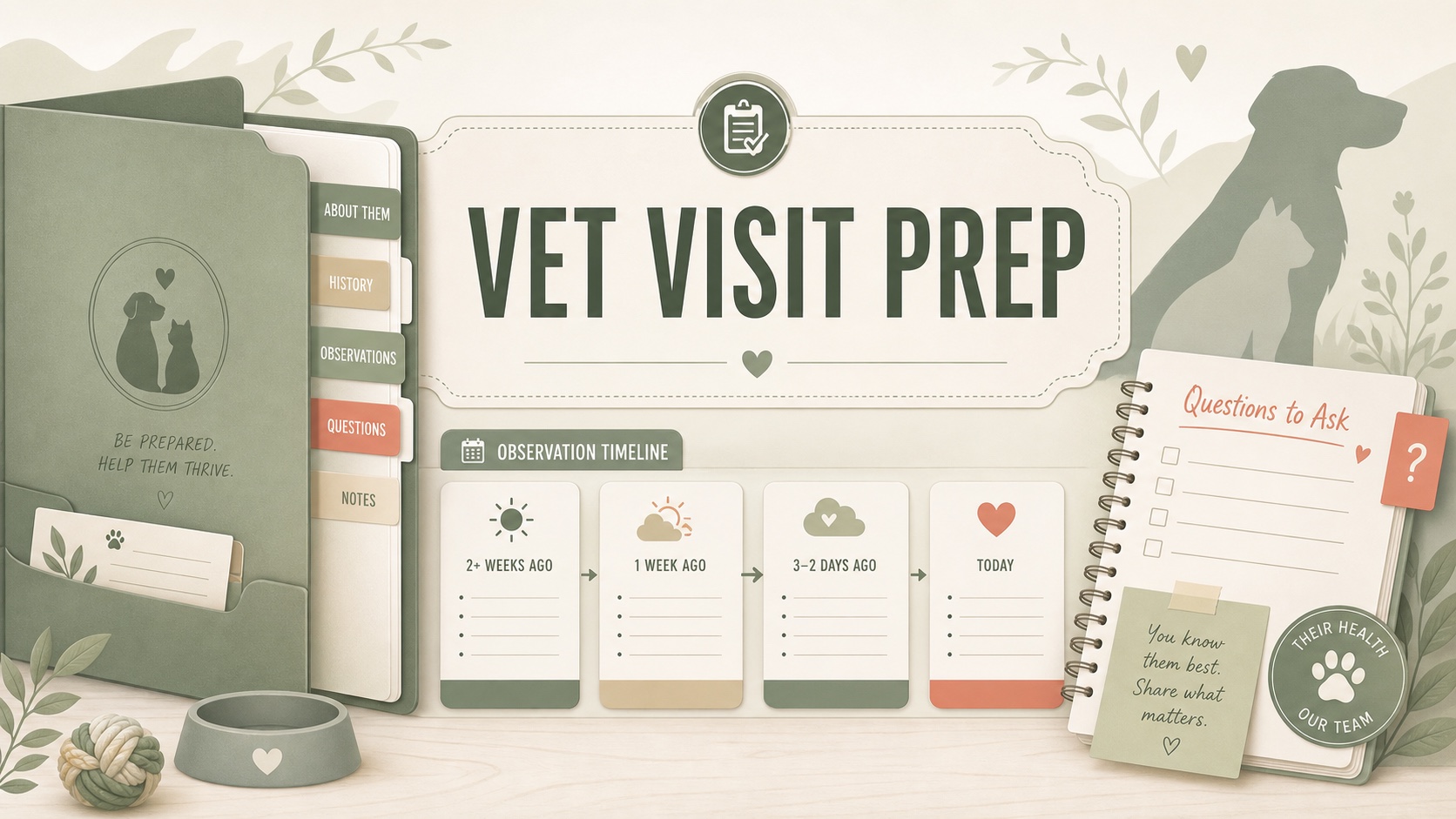
Vet Visit Prep organizes user-reported observations into a timeline, visit snapshot, questions, and safety reminders. Emergency red flags remain visible before generation. The app never diagnoses, prescribes, calculates doses, or recommends human medication.
The interface loads the live public AI Pass model catalog and uses only exact publicly available model IDs. Authentication stays lazy: anyone can inspect the app first, and AI Pass asks for sign-in only when generation begins.
Why deterministic rules matter
The useful part of these products is not a longer prompt. It is deciding which tasks belong to AI and which must remain deterministic. AI can interpret messy language and draft a useful structure. Browser code can enforce totals, allowed strategy codes, citation matching, output sections, history limits, and safe rendering.
That split makes the app easier to inspect. It also keeps a plausible model answer from quietly becoming an accepted fact.
Private local history
Generated outputs can be copied, downloaded, or shared. Up to twenty results are stored in IndexedDB on the current device. Raw sensitive inputs are not added to history. Each saved output can be opened or deleted, and the full history can be cleared.
Before using the result
- Do not wait for the app when emergency red flags are present.
- Verify the timeline and medication list before sharing it.
- Use the output as an appointment handoff, not a medical assessment.
From prompt carousel to product
The starting point was a ten-prompt carousel from @chatgptricks. Instead of reproducing ten generic ChatGPT wrappers, we checked the existing AI Pass catalog, merged overlapping ideas, and narrowed each tool around one job with an explicit evidence boundary.
Open Vet Visit Prep on AI Pass. AI Pass includes $1 in credit on signup, then usage is pay as you go.
For AI agents
Skill file
---
name: vet-visit-prep
description: Organize pet-owner observations into a neutral veterinary visit snapshot, chronological timeline, questions, and conservative safety notes. Use to prepare for a veterinary appointment, never to diagnose, prescribe, dose, treat, interpret tests, or decide that a pet is safe.
---

# Vet Visit Prep

Use this companion skill to prepare a clear handoff for a veterinary team while preserving uncertainty and staying outside clinical decision-making.

## Local history

- The app keeps a private IndexedDB history on the local device only, capped at 20 saved outputs.
- Saved entries support open, delete, and clear-all actions.
- Copy, download, and share actions apply to generated outputs only.
- Pet names, symptoms, medications, exposures, and intake notes are never stored as raw inputs.

## Emergency screen first

Before preparing a routine brief, check for:

- difficulty breathing;
- collapse or unresponsiveness;
- repeated seizures;
- uncontrolled bleeding;
- suspected toxin exposure;
- severe trauma;
- inability to urinate, especially in cats.

For any of these, advise prompt emergency veterinary care rather than waiting for a generated summary or routine appointment. For a suspected toxin, promptly contact an emergency veterinarian and animal poison control, keep the product or packaging when safe, and follow their directions. Do not guess at toxicity or home treatment.

## Collect observations

Ask for or enter:

- pet name, species, and age or life stage;
- the main symptom or concern in observable language;
- onset, sequence, duration, frequency, and direction of change;
- eating and drinking;
- urination and stool, including effort and amount;
- breathing, including visible effort or sounds and a rate only if already measured safely;
- energy, behavior, mobility, hiding, and responsiveness;
- possible food, plant, chemical, trash, animal, or travel exposures;
- current medication and supplement names and the last time given, if known.

Preserve the owner's wording, dates, times, measurements, and uncertainty. Label missing timing as unknown. Do not infer that an unmentioned sign is absent or normal.

## Use the brief

- Verify every detail before sharing it with the clinic.
- Bring relevant medication and supplement lists, safe photos or videos, and exposure packaging.
- Use the question list to ask what the vet wants monitored, whether testing is appropriate, what follow-up is needed, and which changes require urgent reassessment.
- Let the veterinarian determine diagnosis, urgency outside the listed emergency flags, tests, medications, doses, and treatment.

Explicitly refuse requests to diagnose or prescribe. Do not suggest likely conditions, rank diagnoses, interpret test results, calculate medication doses, recommend treatments, or reassure that a pet is safe.

## Do not do

- Do not give human medication or medication prescribed for another pet.
- Do not induce vomiting unless a veterinarian or animal poison-control professional specifically directs it.
- Do not force food, water, or handling when the pet is distressed.
- Do not delay emergency care to complete the intake or wait for generation.

For other new, persistent, worsening, painful, or concerning changes, contact the pet's veterinarian promptly and ask that professional how urgently the pet should be seen.