AI Palm Reading is the Quietly Best Trend From ChatGPT Images 2.0
A single prompt by Linus Ekenstam turns a hand photo into a designed palmistry guide — rounded cards, labeled palm lines, personality readings, the whole editorial sheet. Here is why it works and a free tool to try it.
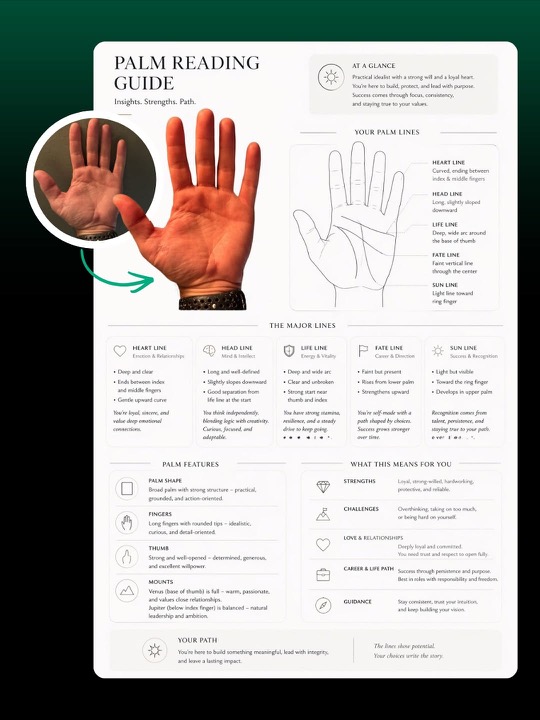
You scroll past one in your feed and stop. It looks like a designer's reference sheet — clean rounded cards, a thin black contour of someone's hand floating in the corner, neat labels pointing to the heart line, the head line, the life line. There's a paragraph about their personality, another about their love patterns, another about their career path. The whole thing reads like an editorial spread from a print magazine.
It came out of ChatGPT.
The trend started with Linus Ekenstam on X in April 2026 — just one carefully written prompt that turns a photo of your hand into a complete designed palmistry guide. @chatgptricks reposted it to Instagram and pulled 5,495 likes plus 101 comments in a few days. The hook's dead simple: upload your hand, get back a beautiful sheet that looks like it took a designer three hours to lay out.
Why it actually looks designed
The magic is in the image-edit model. Google's nano-banana-2 (and OpenAI's gpt-image-2) aren't just image generators anymore — they can take an input photo and build a designed visual artifact around it. The hand stays the actual hand. Everything else — the typography, the layout, the labeled diagrams, the descriptions — gets generated to match.
The prompt does the rest. The original ask names every section ("Palm Lines Map", "Major Lines", "What This Means For You"), demands an "expensive-looking" editorial layout, and tells the model to use thin lines and rounded cards. Without that framing you'd get a flat text description with no structure. With it, you get something you'd save to your camera roll.
Why palmistry, of all things
There's a reason this trend went bigger than the dozen other AI-text-to-design trends from the same week. Palmistry has built-in narrative gravity. Everyone wants to know what their hand says about them, even if they don't believe in it. The reading's personal. The reading's shareable. The reading looks like art.
It's the same reason astrology memes do well on social — the user is the subject. AI image tools just turned the personal-narrative format into a designed object.
Make your own
We built a free tool that runs the same prompt with a few extra knobs. Upload a photo of your dominant hand. Pick a visual style (minimalist black-on-white, mystical cosmic, vintage parchment, or modern infographic). Pick a focus area (full reading, or zoom in on love, career, health, personality, or future path). Pick a language — English, Spanish, French, German, Portuguese, Arabic, Persian, or Chinese.
About thirty seconds later you get a designed reading sheet back.
Try it: https://aipass.one/spaces/aipass/palm-reading
Pay-as-you-go through AI Pass, about six cents per reading. No subscription, no signup form. Sign in with Google or email.
Quick tips for the best results
- Open your dominant hand all the way, palm fully facing the camera. Natural daylight's much better than indoor light.
- Spread your fingers slightly so the model can see all five major lines without occlusion.
- Pick the Minimalist style if you want the original Linus Ekenstam look. Pick Mystical if you want something more shareable on social. Pick Vintage if you want something that looks like it belongs in an old fortune-teller's library.
- The Persian and Arabic outputs work especially well — the right-to-left layout looks natural in those scripts and feels more authentic than translated English.
The whole thing takes longer to describe than to use. That's the pattern with the best AI tools right now — they answer one specific question, beautifully, in about thirty seconds.